


The Power of a Name: Transforming Business Interactions with Professional Name Badges
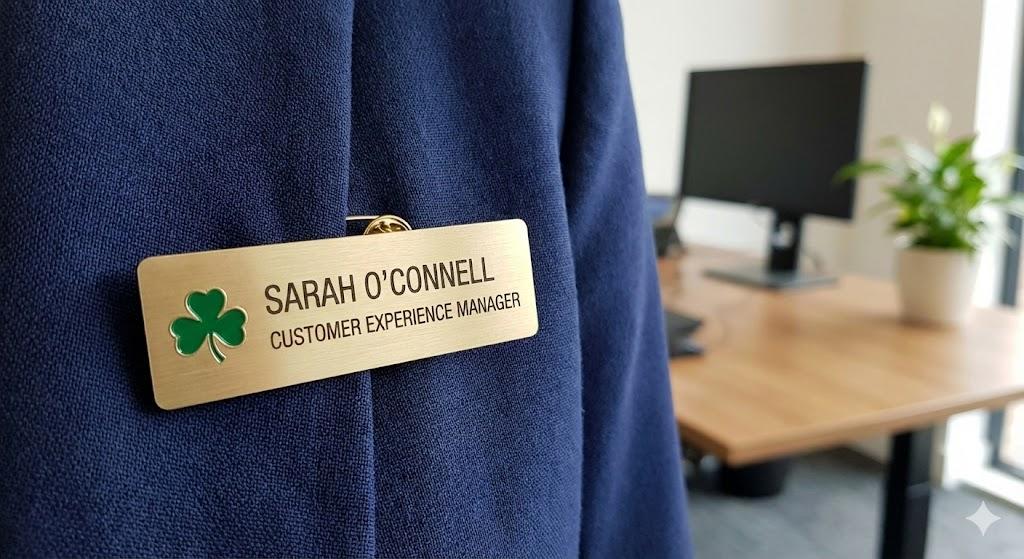
In the complex machinery of modern business, we often obsess over the large components: the marketing strategy, the store fit-out, the website UI, or the quarterly projections. Yet, human connection remains the oil that keeps the machine running smoothly. In face-to-face interactions, there is one tiny tool—often measuring no more than 75mm by 25mm—that does more to facilitate this connection than almost anything else. It is the humble name badge.
While they may seem like a minor administrative detail, name badges are, in reality, a critical component of brand identity and customer service psychology. Whether you are running a bustling café in Cork, a high-end hotel in Dublin, or a multinational corporate event, the presence (or absence) of a name badge can fundamentally alter the dynamic between staff and visitors.
This guide explores why these small rectangles of metal or plastic are so vital, the different styles available to suit your brand, and how to ensure you are making the right impression from the very first "Hello."
The Psychology of the Name Badge
To understand the value of a name badge, we have to look at the psychological concept of "social friction." When a customer enters a business, there is a natural, invisible barrier. They are on unfamiliar territory; the staff are strangers. If a customer needs help, there is a micro-moment of hesitation: Who do I ask? Is that person working here? How do I get their attention without being rude?
Name badges dissolve this friction instantly.
-
Breaking the Ice: A badge acts as an immediate introduction. It gives the customer permission to engage. Knowing a person’s name humanizes the interaction, moving it from a transaction between "Customer and Worker" to a conversation between "Sean and Sarah."
-
Accountability and Trust: In sectors like healthcare, finance, and security, a name badge is a symbol of accountability. It signals that the wearer is authorized, trained, and responsible for their actions. It builds trust subconsciously—we are wired to trust people who are not hiding their identity.
-
Professional Uniformity: A badge ties a uniform together. It shows that the company cares about presentation. A staff member in a smart shirt looks good; a staff member in a smart shirt with a polished metal name badge looks like a professional representative of a brand.
Choosing the Right Material for Your Brand
Not all badges are created equal. The material you choose sends a subtle message about your brand's values and price point. When sourcing name badges, you will typically encounter three main categories.
1. The Executive Metal Badge
For industries where prestige and high standards are paramount—such as 5-star hotels, luxury retail, legal firms, and corporate consultancies—metal is the standard.
-
The Look: Available in gold, silver, or bronze finishes, these badges catch the light and look like a piece of jewellery.
-
The Feel: They have a reassuring weight. When printed with a high-quality logo and finished with a resin dome (a clear coating that adds a 3D effect), they are incredibly durable and scratch-resistant.
2. The Durable Plastic Badge
This is the workhorse of the retail, healthcare, and service industries. Modern plastic badges are far removed from the brittle tags of the past.
-
The Look: They offer excellent colour reproduction. If your brand relies on a specific, vibrant shade of red or blue, plastic (often with a white base) ensures your logo looks exactly like it does on your website.
-
The Versatility: They are lightweight, easy to clean (crucial for healthcare settings), and cost-effective for large teams.
3. The Reusable "Window" Badge
High staff turnover is a reality in many sectors, such as seasonal hospitality, events, or volunteer organizations. Ordering a new permanent badge for every temporary staff member is costly and wasteful.
-
The Solution: Window badges feature a permanent printed logo section and a slot where a paper insert with the name can be slid in.
-
The Benefit: They look professional (much better than a sticker) but offer total flexibility. When a staff member leaves, you simply change the paper insert.
The Great Debate: Pin vs. Magnet
When ordering name badges, the fastening is just as important as the front face. For decades, the safety pin was the default. However, the pin has a major drawback: it punches holes in clothing.
If you have invested in high-quality uniforms—expensive blouses, waterproof jackets, or fine wool blazers—the last thing you want is for your staff to poke holes in them every morning. Over time, this ruins the fabric.
This is why the magnetic fitting has become the industry favorite. A strong magnet bar sits inside the shirt, holding the badge firmly in place without piercing the fabric. It sits flat, doesn't droop, and preserves the life of the uniform. While magnets are slightly more expensive than pins, the savings on ruined uniforms make them the smarter financial choice in the long run.
Design Best Practices: Less Is More
You have a small canvas, so design discipline is essential. The primary goal of a name badge is readability.
-
The Hierarchy: The staff member's first name should be the largest element. It should be readable from a conversational distance (about 3 to 4 feet).
-
The Logo: Your brand needs to be there, but it shouldn't fight the name for attention. Place it clearly at the top or side.
-
Job Titles: Use these sparingly. "Manager" or "Pharmacist" is useful because it conveys authority. "Junior Assistant to the Regional Sales Coordinator" is too long and creates visual clutter.
-
Fonts: Avoid script or "handwriting" style fonts. They are hard to read quickly. Stick to clean, sans-serif fonts like Arial, Helvetica, or Open Sans.
Sourcing Quality in Ireland: Abbey Badges
In an era of generic online marketplaces, there is a significant risk in ordering custom products from anonymous overseas suppliers. Issues with colour matching, spelling errors, and long shipping delays can turn a simple order into a headache.
For Irish businesses seeking reliability and craftsmanship, Abbey Badges has established itself as the premier partner for professional identification. Based in Dublin, they understand the nuances of the local market, from the need for bilingual (Gaeilge/English) badges in the public sector to the specific branding requirements of Irish SMEs.
What sets Abbey Badges apart is their comprehensive service. They don't just sell a product; they guide you through the creation of it. They offer a Free Design Service, which is invaluable for businesses that may not have an in-house graphic designer. You can send them your logo and a rough idea, and their team will produce a professional proof, ensuring you know exactly how the metal or plastic finish will look before production begins.
Whether you need a sleek, gold-finished badge with a magnetic backing for a hotel reception team, or a durable, reusable window badge for a summer festival crew, their range covers every requirement. They prioritize quality materials that withstand the wear and tear of daily work environments.
If you are looking to upgrade your team's appearance, you can explore their full range of options at abbeybadges.ie.
Conclusion
A name badge is a small investment that yields high returns. It creates a welcoming atmosphere, empowers your staff to take ownership of their interactions, and presents a polished, unified brand image to the world.
Whether you choose a prestigious metal finish or a practical reusable design, the key is consistency and quality. By paying attention to the details—the font, the fastening, and the manufacturer—you ensure that every time your staff steps onto the floor, they are representing your business in the best possible light. In the world of customer service, names matter. Make sure yours are worn with pride.
Sponsored
Sponsored
Categories
- AI
- Design
- Fashion and Art
- Investment and Finance
- Top 10
- Christianity
- Climate and Enviroment
- Writing and Film
- Fitness
- Food
- Games
- Gardening
- Health
- Home and Interiors
- Marketing and Sales
- Music
- Making Money Online
- Others
- Books
- Religion
- Ecommerce
- Sports
- Cars
- Wellness
- Tech Gadgets
- Events
- Governments and Nations
- Science and Engineering
- Real Estate
- Travel, Tourism and Hospitality
- Education
- Startups
- Beauty and Cosmetics
- Agriculture
- Computer Operating Systems
- Crypto
- Politics and News
- Video Review
- Immigration
Read More
Executive Summary Carmine Market: Share, Size & Strategic Insights Data Bridge Market Research analyses that the global carmine market to account USD 52.31 million by 2029 growing at a CAGR of 6.80% in the forecast period of 2022-2029. For an excellent outcome of Carmine Market report, qualitative and transparent research studies are carried out devotedly for the specific niche....

Introduction Anti Social Social Club (ASSC) has grown from a niche streetwear label into a global fashion movement, and Mexico is no exception to its influence. Known for its minimalist designs, emotional messaging, and limited-edition drops, ASSC has found a strong audience among Mexican youth who embrace streetwear as a form of self-expression. In Mexico, where fashion is deeply connected to...
In-Depth Study on Executive Summary Processed Vegetable Market Size and Share The global processed vegetable market size was valued at USD 260.24 Billion in 2024 and is projected to reach USD 125.01 Billion by 2032, with a CAGR of 9.50 % during the forecast period of 2025 to 2032. The world class Processed Vegetable Market business report presents with the continual knowledge and...
Global Resistance Welding Products Market was valued at USD 1802.00 million in 2021 and is expected to reach USD 2872.11 million by 2029, registering a CAGR of 6.00% during the forecast period of 2022-2029. The global business landscape is undergoing a transformation, with industries increasingly leaning on deep research and actionable insights to make strategic decisions. One segment...
Not all smoke shops are created equal. After you type "smoke shop near me" into your phone and get a list of options, it is tempting to assume they are all interchangeable. This is a critical mistake. The reality is that the market has many low-quality, unprofessional, or untrustworthy retailers. A great shop, like Paradise Vape & Smoke Shop - Sandy Springs | CBD & Hookah, sets a high...
